The Risoux tonewood
Tonewood spruce
I look for my woods in every forest, as far as I need to go. Near home I cut them myself, in the Risoux above all, with the support of the Office national des forêts. I also use old stocks, bought near Rougemont, in the Pays-d'Enhaut, in Switzerland.
Local woods
At the moment, one project is close to my heart: building instruments and bows from local woods alone. Boxwood, black locust, spruce, beech, cherry, maple. All of them grow a few kilometres from the workshop.
The choice of log
It all begins there, with the choice of log, long before the first cut of the gouge.
I look at the grain, I count the rings, I tap the wood and listen. Fewer than one tree in a hundred meets a maker's requirements. This is a rule of the trade, confirmed in practice, rather than a measured figure.
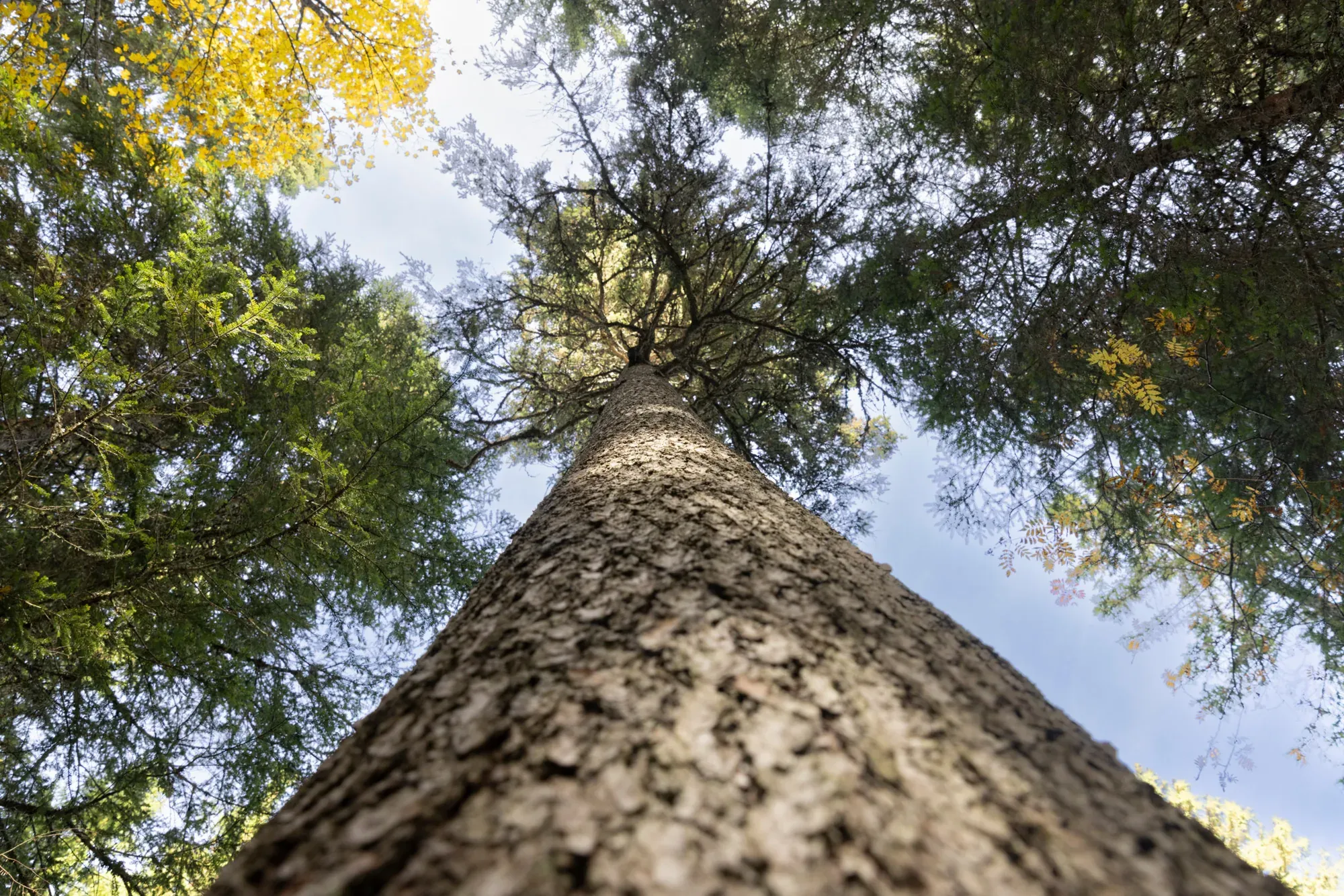
The Risoux, on the Jura range
The moment of felling
Risoux wood has a mixed reputation today, and the moment of felling has something to do with it. The season, the phase of the moon: traditional knowledge largely forgotten, long held to be mere belief.
Ernst Zürcher, forest engineer from ETH Zurich and professor emeritus at the Bern University of Applied Sciences, has nonetheless measured an effect. On spruce, the felling date makes the behaviour of the wood vary as it dries, slightly but in a statistically significant way.
E. Zürcher, R. Schlaepfer, M. Conedera, F. Giudici, “Looking for differences in wood properties as a function of the felling date”, Trees, vol. 24, 2010, pp. 31 to 41.
Little enough for an ordinary board. A great deal for a soundboard. It is in that spirit that I choose my logs.